
Authentic Wagyu
; [/insert_php]/images/main-img-pages-wagyu.jpg)
Poseidon Group supplies a wide variety of Wagyu beef from different parts of Japan. Our Wagyu beef comes from 6 branches of ZEN-NOH (Japan Agricultural Cooperatives Group) in 5 prefectures -- Iwate, Gunma, Kumamoto, Miyazaki, Kagoshima (2 branches).
From those locations known for the highest quality of Wagyu, we carefully select only the top-quality Wagyu beef of A5, A4 grade to import to the United States.
In October 2017, we imported to the United States, one Wagyu cattle from Kagoshima, which won the 3rd prize at the “Wagyu Olympics” in Japan. We’ve served it at our affiliated restaurant Wadatsumi in Torrance, California for a limited time.
We plan to purchase a Wagyu cattle and widely introduce different regions of the Wagyu to customers in the United States regularly.
Starting in 2018, we are opening a processing facility approved by USDA, within our facility. We will be able to offer not only loin (lump of meat at each region) but also custom-processed meat according to customers’ needs, such as steak, sukiyaki and grilled meat.
Gallery


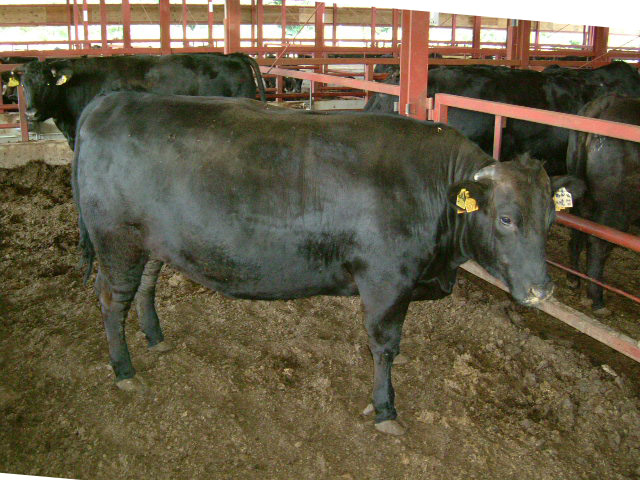
Wagyu (Native Japanese Cattle)
Wagyu beef is a unique resource of Japan with exceptionally tender and juicy flesh quality unrivaled to any other beef in the world.
Wagyu cattle farmers raise them with special care, feeding soybeans high in protein and corn and wheat bran that are high in starch. Livestock farmers also wash, dry and brush the Wagyu cattle with their own hands. This gives the effect of massaging while cleaning, and improves blood circulation of the Wagyu.
In order to produce the best quality beef, Wagyu producers spend extra time and effort. Wagyu is any of four Japanese breeds of beef cattle -- Japanese Black (Kuroge Washu), Japanese Brown (Akage Washu), Japanese Polled (Mukaku Washu) and Japanese Shorthorn (Nihon Tankaku Washu).
Each Wagyu cattle has a unique name which is useful for tracing information such as its origin, farm, breeding, etc.
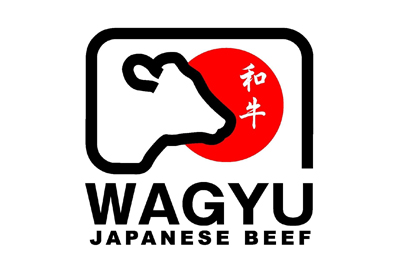
Wagyu Unification Mark
Only beef from a “genuine Japanese Wagyu” with a pedigree of the cattle born and raised in Japan can bear this mark on the package.
The mark is managed by the Japanese Ministry of Agriculture, Forestry and Fisheries (MAFF), and there are strict conditions (breed, coat color, characteristics) to obtain the mark. Enacted in 2007, this mark was created as a symbol to authenticate Wagyu with the hope to spread its deliciousness of authentic Japanese beef to people all over the world.
"Wagyu unification mark" guarantees the highest quality Wagyu beef.
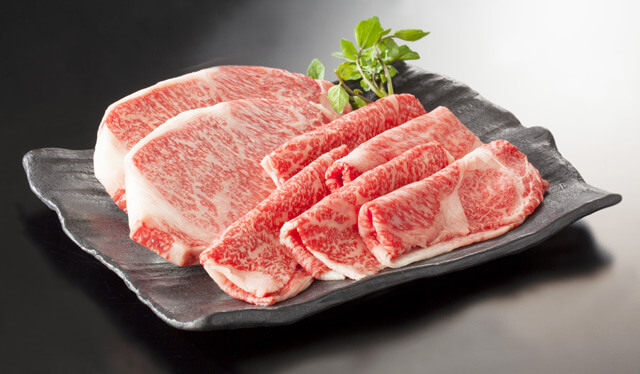
Quality and Umami of Wagyu
Carefully raised Wagyu beef is known for its appearance with beautiful patterns and is called marbled meat. In addition to mild natural taste, it offers luxurious aroma (some compare its scent to that of coconut or fruit).
With excess amino acid and unsaturated fatty acid contents that are the basis of umami, Wagyu beef is extremely tender and it almost melts in your mouth. The deliciousness of Wagyu beef comes from its exceptional flavor, aroma and texture, all three important factors of taste.
Cuts of Beef and Their Characteristics
16 Parts of Beef and Their Main Characteristics, Based on Food Retail Quality Standards
1 Neck
Lean and tough. Usually prepared as minced or chopped meat. Also good to dice for stewing.
2 Chuck Tender
Slightly hard lean meat with little fat. Rich in extracts and collagen. Good for stewed dishes and soup.
3 Chuck Roll
Moderately fatty and flavorful. Slightly gristly, so best used sliced for shabu shabu, sukiyaki and yakiniku.
4 Ribeye
Fine texture. Great for roast beef or steak. The marbled meat is good for sukiyaki.
5 Striploin
Finely textured, tender and flavorful. Especially great for steak and also good for roast beef and shabu shabu.
6 Tenderloin
Finely textured and tender with less fat. Good for Beef cutlet, but steak would be a less greasy option.
7 Shoulder Clod
A darker lean meat with moderate toughness and little fat, this portion retains great taste nonetheless. Great for a range of dishes, the inherent strong flavor makes it ideal for steaks and barbequing, while the full flavor and high collagen content makes it ideal for stews and curries.
8 Brisket
A deep-layered section of lean meat and fat content, this is a marbled portion boasting excellent rich flavor. In addition to being ideal for thinly-sliced Japanese BBQ or grilled dishes, this portion cut into cubes makes for great stews or pot-au-feu.
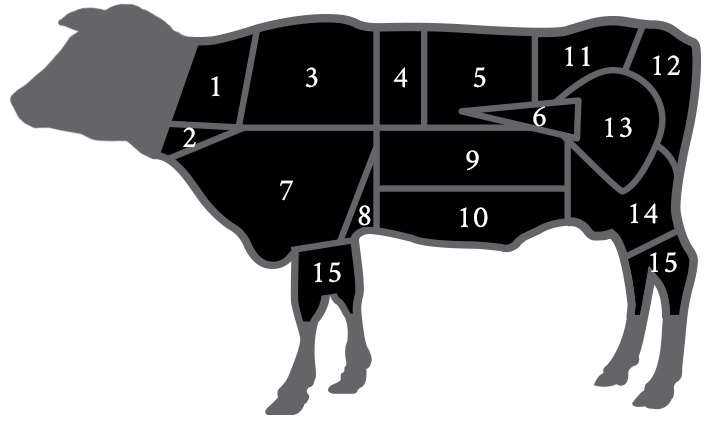
9 Short Rib
Although this is a grainy portion high in fiber and membrane content, this cut is blessed with fantastic richness while providing a moderate balance between lean meat and fat. Great for grill and BBQ dishes including steaks and Japanese BBQ.
10 Short Plate
Although grainy, this cut provides a full, rich flavor with a moderate blend of leanness and fat. Perfect for thinly-sliced meat dishes including Japanese BBQ, sukiyaki and shabushabu.
11 Rump
Tender and savory lean meat. Good for a wide range of dishes including steak and roast beef.
12 Gooseneck Round
Moderately grainy, this cut is a tough portion with little fat content. Ideal for cutting into cubes and stewing or thinly-slicing for sukiyaki , shabushabu and stir-fries.
13 Top Round
Although this cut is a lean portion with low fat content and somewhat grainy, it is nonetheless tender. Boasting the delicious taste true to good meat, top round is great for steaks or roast beef and ideal for Japanese BBQ or using in stews.
14 Knuckle
Although the outer layer of this cut is somewhat grainy, this portion is extremely lean and boasts a fine texture on the inner region of the thigh. The central portion is tender and great for steaks and roast beef. As the outer layer is somewhat grainy, it can be cut into small pieces and used for Japanese BBQ or in stir-flies.
15 Shank
Stringy, but when cooked for a long time, the collagen flows out and softens the meat. Good for stewed dishes such as stew and curry. Using pressure cooker would save you time.
Meat Grading System
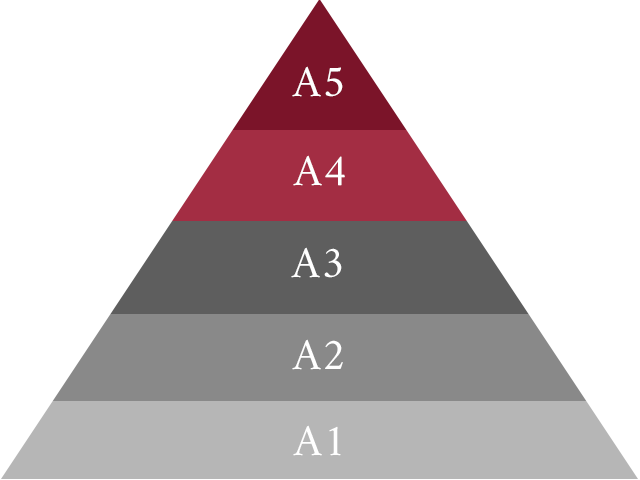
A meat grading system has been developed by Japan Meat Grading Association to standardize the evaluation of meet, in order to ensure fair trading. The grades are classified by the basis of the yield grade and meat quality grade. The yield grade refers to the ratio of meat to the total weight of the carcass, and the meat quality grade is based on fat marbling, color, brightness, firmness and texture.
At Poseidon Group International, we specialize in only high quality marbled beef with grade A5 and A4.